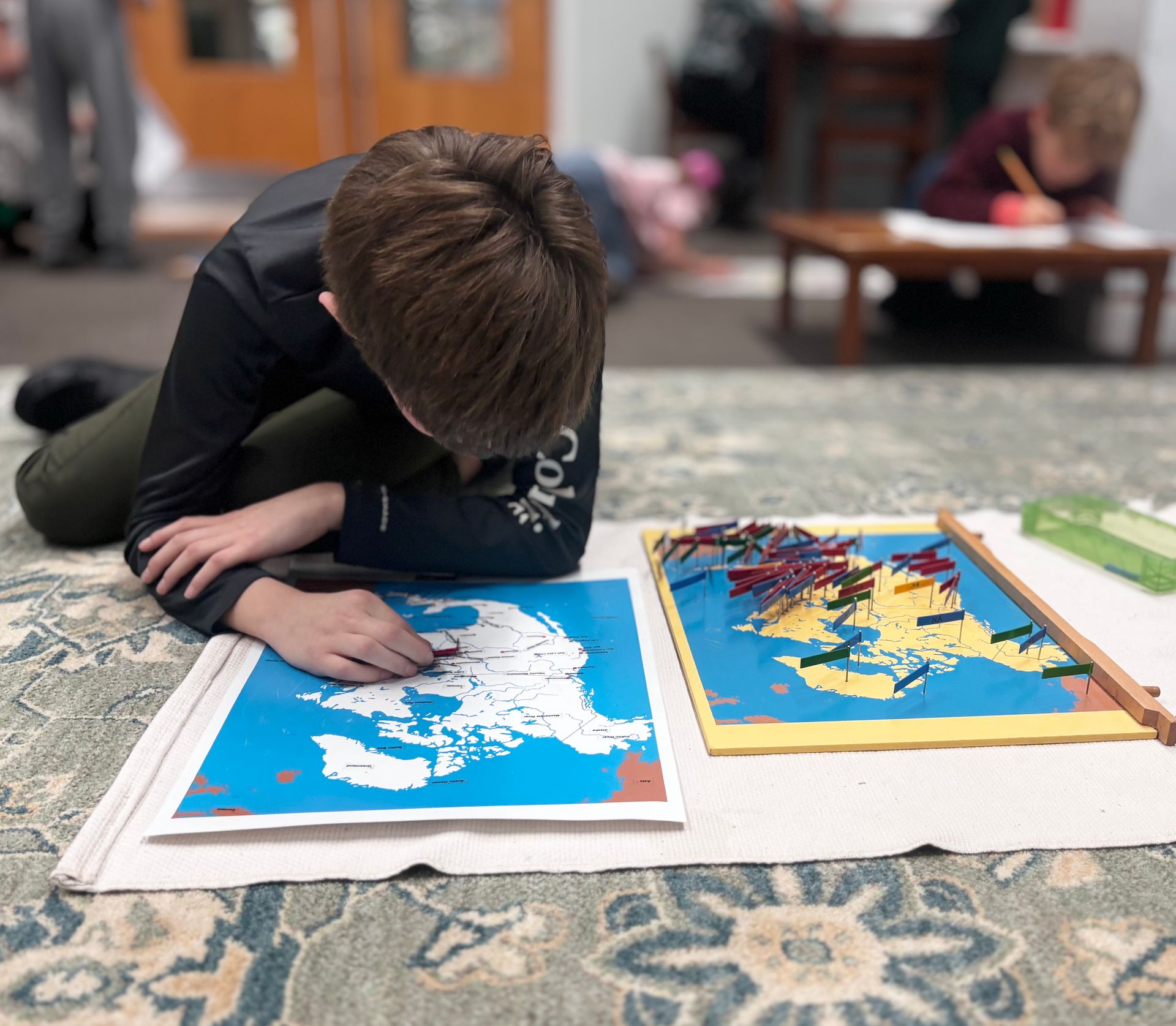

Perhaps you have heard about self-directed play, also known as open-ended or unstructured play. While it is occasionally discussed in modern parenting circles as a recent trend, the reality is that the concept is foundational to child development. Within the Montessori philosophy, we understand that what adults view as play is actually the child's essential developmental work.
Once you understand the underlying mechanics of self-directed activity and establish a basic framework at home, supporting this process becomes a seamless part of your daily family rhythm. By aligning your home environment with these principles, you directly mirror the independence and internal motivation we cultivate in the Montessori classroom.
Understanding Self-Directed Work
When a child uses simple, unscripted materials in creative ways with no adult-imposed outcome, they are engaging in self-directed activity.
Many modern commercial toys are designed with a single, highly specific purpose. Consider a plastic dinosaur or a motorized toy train. While these items certainly have a place, the way a child can interact with them is inherently limited by the object's rigid definition. The toy directs the child's actions.
Now, consider a cardboard tube or a plain wooden block. The operational possibilities are infinite. A tube might be treated as a telescope, a megaphone, a structural bridge, or a marble run. Because the material is simple, the child must provide the intelligence, imagination, and execution.
When introducing these opportunities at home, the most critical element is the role of the adult. It is our natural tendency to project predetermined goals onto a child’s activity or to instinctually step in and demonstrate the correct way to utilize an object. Embracing a Montessori approach means giving yourself permission to step back. By observing quietly without intervening, you allow the child to discover their own sequence, solve their own structural problems, and experience true cognitive concentration.
Developmental Benefits of Unstructured Activity
- Cultivates Internal Motivation: When adults refrain from defining the success of an activity or offering external praise, children connect with the innate joy of the task. They naturally challenge themselves to test new, innovative concepts simply for the satisfaction of discovery.
- Fosters Functional Independence: True independence requires the freedom to act safely on one's own. Self-directed work allows children to experience agency from a young age within a prepared, secure home environment.
- Strengthens Creative Problem-Solving: Constructing a game or building a structure from raw materials requires continuous assessment. If a component collapses or a rule fails to work, the child must evaluate the error and modify their approach independently.
- Builds Authentic Confidence: Through independent exploration, children realize they are capable of affecting their environment and solving problems without adult direction. This creates a secure internal sense of competence.
- Respects Individual Developmental Rhythms: Self-directed activity carries no external timelines, pressures, or academic benchmarks. It permits children to absorb, manipulate, and build upon concepts day after day at a pace that aligns with their specific neurological needs.
Implementation Guide for the Home
To successfully establish a space for self-directed activity in your home, focus on three primary operational areas.
1. Curate Open-Ended Materials
Select simple, high-quality items that can serve multiple functions. Prioritize raw, natural elements like wood, cotton, metal, and clay over synthetic plastics.
Excellent foundational materials include:
- Solid wooden blocks or cardboard boxes
- Fabric scarves or cotton cloths
- Smooth stones, large seashells, or polished wood rounds
- Modeling clay or basic playdough
Many families find success by preparing a loose parts basket or tray. This involves placing an assortment of interesting textures—such as large buttons, pinecones, dried seed pods, and short pieces of rope—into a low, accessible container for the child to categorize, arrange, and manipulate.
2. Prepare the Physical Space
Ensure your child has a clearly defined, safe area in which to move and work. This could be a specific corner of the living room, a section of their bedroom, or a secure outdoor space.
The environment must allow for full flexibility of movement. Ensure the setup allows the child to safely sit, stand, reach, and safely test their physical balance. Store these open-ended materials on low, open shelves in neat baskets rather than in a deep toy box, making it easy for the child to choose an activity independently, complete their work, and return it to its designated home.
3. Shift the Adult Role
The final step is managing our own presence. Because the environment is safely prepared and the materials are self-correcting, you do not need to manage the play.
Sit nearby and enjoy watching the depth of your child's concentration. If you are invited to join, take a passive, supportive role rather than a leading one. Let your child dictate the narrative, set the boundaries of the game, and explore the limits of their own imagination.