Have you ever wondered how Montessori guides teach language? Parents observing our classrooms are often amazed to see young children writing stories, decoding complex words, and analyzing sentence structures with joy and ease.
What’s the secret? There isn't one—our approach simply honors a child’s natural physical, cognitive, and social development. Here is how language unfolds at Acorn, from the Toddler and Primary years through Elementary.
1. Spoken Language and the Absorbent Mind
Dr. Maria Montessori identified that children from birth through age six possess an "absorbent mind"—an extraordinary ability to effortlessly absorb language, concepts, and culture directly from their environment.
In our Primary classrooms (ages 3–6), we build on this foundation by surrounding children with rich spoken language:
- Songs and Poetry: Children hear and experience rhythm, rhyme, and word play in engaging, interactive ways. We encourage families to do the same at home by sharing classic childhood poems or enjoying music from child-centered artists like Raffi or Tom Chapin.
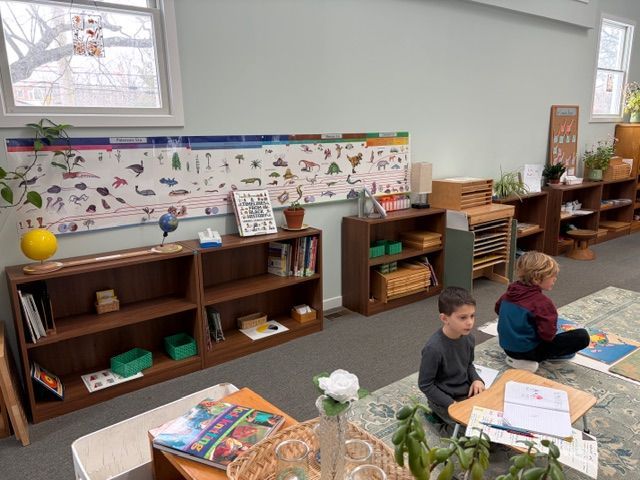
- Specialized Vocabulary: Rather than using simplified terminology, Montessori guides introduce rich, precise vocabulary early on. Children learn exact nomenclature for plant structures, geometric shapes, geographic landforms, and animal classifications.
2. Writing Comes First
In traditional education, children are often taught to read before they learn to write. In Montessori, writing naturally precedes reading.
When you consider the core goal of writing, it is simply the ability to visually communicate thoughts using standardized symbols. This process is distinct from the physical mechanics of holding a pencil.
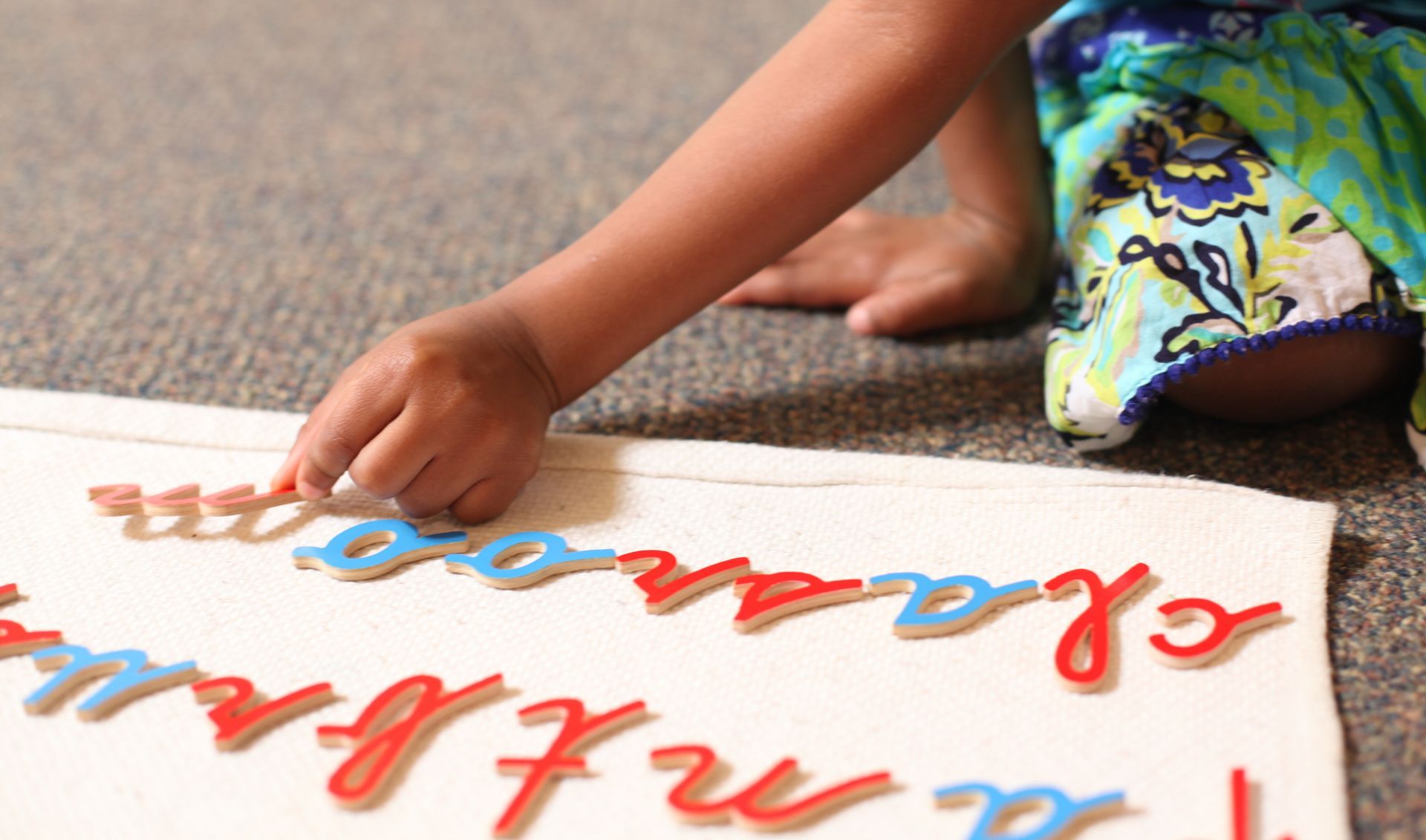
The Moveable Alphabet
Once a child understands basic letter sounds, they are introduced to the Moveable Alphabet—a wooden box of organized letters. Long before their hand muscles are developed enough to write sentences on paper, children use these wooden letters on a work mat to build words and express complex thoughts. At this stage, we honor "inventive spelling" (such as spelling "I love my mom" as "I luv mi mom"). This allows creative expression to flow freely without being stalled by spelling rules.
Preparing the Hand
Simultaneously, children engage with hands-on materials that build finger strength, fine motor coordination, and proper pencil grip. Traditional pencil-to-paper writing typically begins around age five or six in Kindergarten, depending on each child's individual readiness.
3. Decoding and Reading Through Movement and Touch
When teaching letters, Montessori guides focus on phonetic sounds rather than letter names. We skip the traditional "Alphabet Song" initially because knowing letter names ("see-ay-tee") does not aid in decoding the word "cat" ("k-ah-t").
- Sandpaper Letters: Children trace textured sandpaper letters with their fingertips while pronouncing the sound. This engages tactile, visual, and auditory muscle memory together.
- Object Boxes: Boxes filled with miniature objects (such as a tiny pig, pin, and pot paired with the letter P) help children link abstract sounds to concrete items.
- Integrated Reading: Reading is never taught in isolation. As children explore history, botany, or zoology, they read age-appropriate informational texts linked directly to their research.
A Quick Tip for Home: To support your child's reading development, refer to letters by their most common phonetic sounds rather than their formal names. Additionally, we ask families to avoid using controlled reading series like Miss Rhonda’s Readers or Bob Books at home. Children quickly memorize these texts, making it difficult for guides to accurately observe true decoding skills at school.
4. Word Study and the Spiraling Grammar Curriculum
As children move into Kindergarten and Lower Elementary (ages 6–9), reading evolves into detailed language analysis.
Rather than relying on mechanical worksheets, grammar is introduced through concrete, interactive materials using a spiraling curriculum—revisiting core concepts with increasing depth as the child matures.
The Function of Words and the Farm
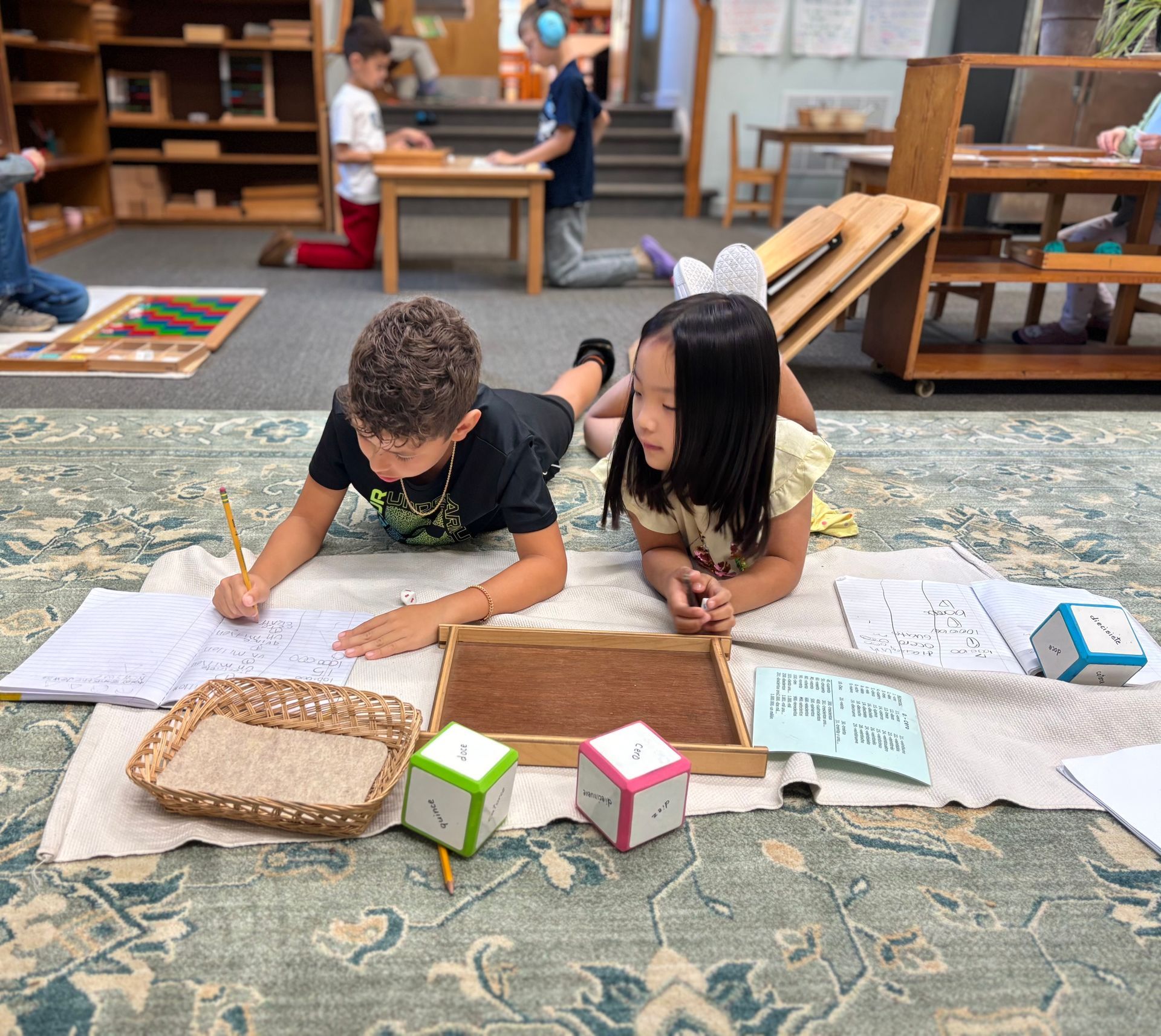
Children are introduced to parts of speech through tangible experiences. Using a miniature farm setup, children place noun labels on animals and objects, apply adjectives ("soft brown horse"), and act out verbs ("gallop"). Each part of speech is assigned a distinct geometric symbol (e.g., a black pyramid for nouns, a red sphere for verbs).
Active Learning Materials
- Command Cards: Children read specific instructions on cards and physically execute them (e.g., "Walk quietly to the door"), experiencing how adverbs modify verbs firsthand.
- Grammar Boxes and Strips: Children build and manipulate physical sentences using color-coded cards, discovering how word placement alters meaning.
- Word Study Skills: Independent card work builds skills in classification, alphabetizing, compound words, synonyms, antonyms, prefixes, and suffixes.
5. Advanced Sentence Analysis
In Upper Elementary (ages 9–12), students transition from identifying individual parts of speech to analyzing sentence structure and syntax.
Beginning with basic subjects, verbs, and direct objects, students gradually progress to analyzing complex structures—including predicate nominatives, attributive adjectives, clauses, and subordinate phrases. Because this work is rooted in concrete exploration from an early age, elementary students approach grammar with enthusiasm and deep comprehension.
Experience Montessori Language in Action
Language in a Montessori classroom is a vibrant, hands-on journey from spoken connection to creative expression and formal analysis.
We invite you to
schedule a classroom observation to see our language materials in action!