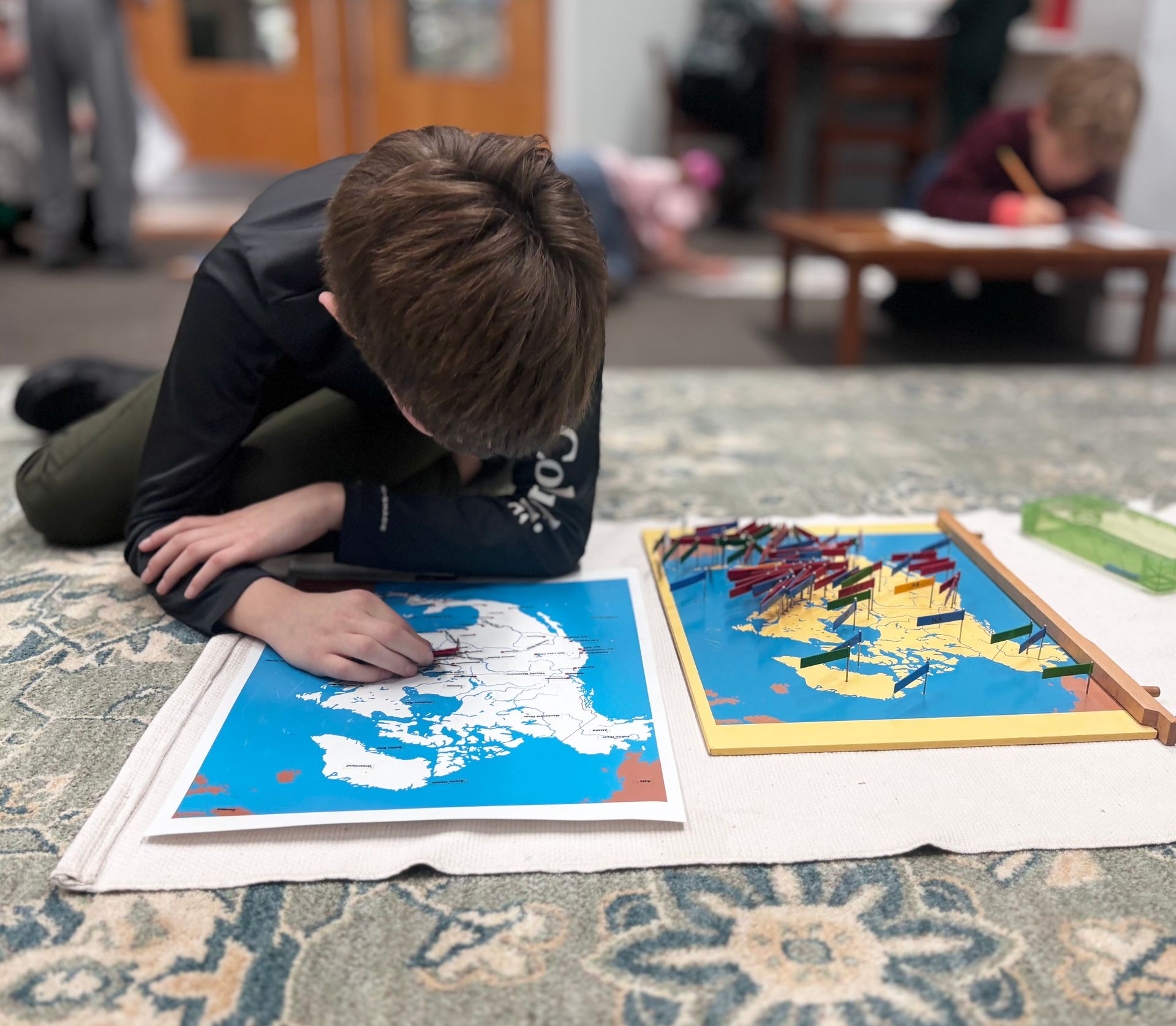
When Dr. Maria Montessori began developing the Elementary curriculum, she recognized a fundamental shift in development. Children in the Second Plane of Development (ages 6–12) have vastly different needs than their younger selves. They are no longer content exploring only their immediate sensory environment. Instead, their scope of vision expands exponentially: social connections become paramount, imaginative capacity explodes, and they develop an insatiable curiosity about the universe, human history, and their place within the big picture.
To serve this developmental shift, Dr. Montessori created Cosmic Education. At Acorn Montessori School, our Elementary curriculum anchors this grand vision through the Five Great Lessons. These dramatic, impressionistic stories act as annual springboards, opening doors in the child’s imagination and providing an interconnected framework for years of academic discovery.
Every year, Elementary students revisit these five foundational stories. Over a child's three-year cycle in our Elementary environment, they experience each lesson three times—each year returning with deeper intellectual maturity, new questions, and fresh insights.
1. The Creation of the Universe (The First Great Lesson)
Typically presented at the start of the school year, this lesson ignites awe and wonder. The Guide prepares impressionistic experiments, props, and visual aids in advance. To set a dramatic stage, the blinds are drawn, lights are dimmed, and quiet music plays as students gather.
The narrative begins before time itself—describing a universe colder and darker than can be imagined, until an instant explosion brings matter, energy, and light into existence. Through storytelling, candle demonstrations, and scientific experiments, students explore particle behavior, states of matter, light speed, solar systems, and planetary formation. The lesson climaxes with a model volcanic eruption, setting the stage for Earth's future.
Academic Extensions: Chemistry, physics, geology, space sciences, physical geography, and the scientific method.
2. The Coming of Life (The Second Great Lesson)
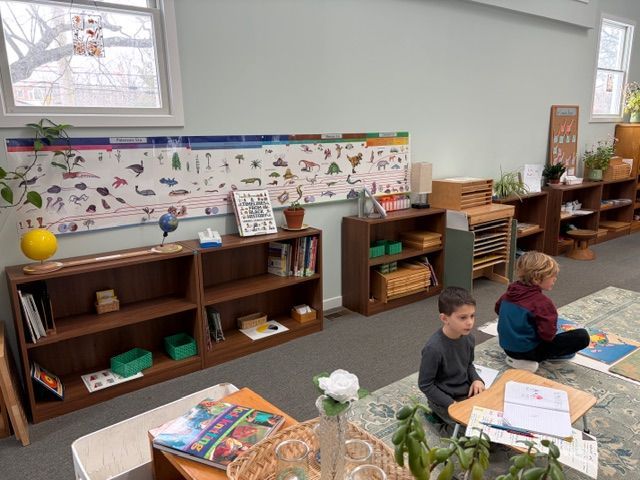
Later in the year, focus shifts to the unfolding of life on Earth. Using striking visual materials—such as the Long Black Strip and the Clock of Eras—children grasp the vastness of geologic time compared to humanity's brief presence. Unrolling a long black fabric strip down a hallway, only to reveal a tiny sliver of white representing all of human existence, offers a humbling perspective.
The centerpiece of this lesson is the Timeline of Life, an illustrated material showing the evolution of single-celled organisms, early marine life, plants, invertebrates, and vertebrates. Children learn how fossils record history and how scientific understanding continually evolves.
Academic Extensions: Biology, botany, zoology (the five kingdoms of life and vertebrate classes), classification, and paleontology.
3. The Coming of Humans (The Third Great Lesson)
This story introduces early human ancestors and the characteristics that make our species unique: our capacity to think, feel, imagine, and collaborate.
Guides introduce the Fundamental Needs of Humans, guiding students to analyze how basic physical and spiritual needs (shelter, clothing, nourishment, art, and community) have been met across different cultures and eras. Learning about humanity's shared past cultivates gratitude, cultural empathy, and a strong sense of belonging within the human story.
Academic Extensions: History, anthropology, cultural geography, archaeology, and social sciences.
4. The History of Writing & Language (The Fourth Great Lesson)
Children are fascinated by the origins of communication. This lesson traces human expression from early cave paintings and pictographs to Egyptian hieroglyphics, the Phoenician alphabet, and modern printing.
For students who are refining their own reading and writing skills, understanding the historic struggle to record thought is deeply empowering. It transforms grammar, spelling, and composition into a meaningful connection with thinkers throughout time.
Academic Extensions: Etymology, grammar, creative writing, literature, historical research, and world history.
5. The History of Mathematics (The Fifth Great Lesson)
Math is presented not as a set of rules to memorize, but as a universal human language invented to solve practical problems. Students learn how early civilizations developed counting systems—from tallying on bones to the body-based systems of the Mayans, Egyptians, and Romans, culminating in the decimal system we use today.
When a student practices long division or geometry in the classroom, knowing the historical origins behind those concepts makes the work purposeful and exciting.
Academic Extensions: Advanced arithmetic, geometry, measurement systems, historical mathematics, and logic.
Discover Cosmic Education at Acorn
The Great Lessons do not teach isolated subjects; they weave history, science, math, and literature into a single, awe-inspiring narrative. By presenting the whole picture first, we give children the keys to explore their world with purpose, enthusiasm, and independence.
Interested in seeing how Cosmic Education unfolds in our Elementary environment? We invite prospective and current families to observe our classrooms in action.