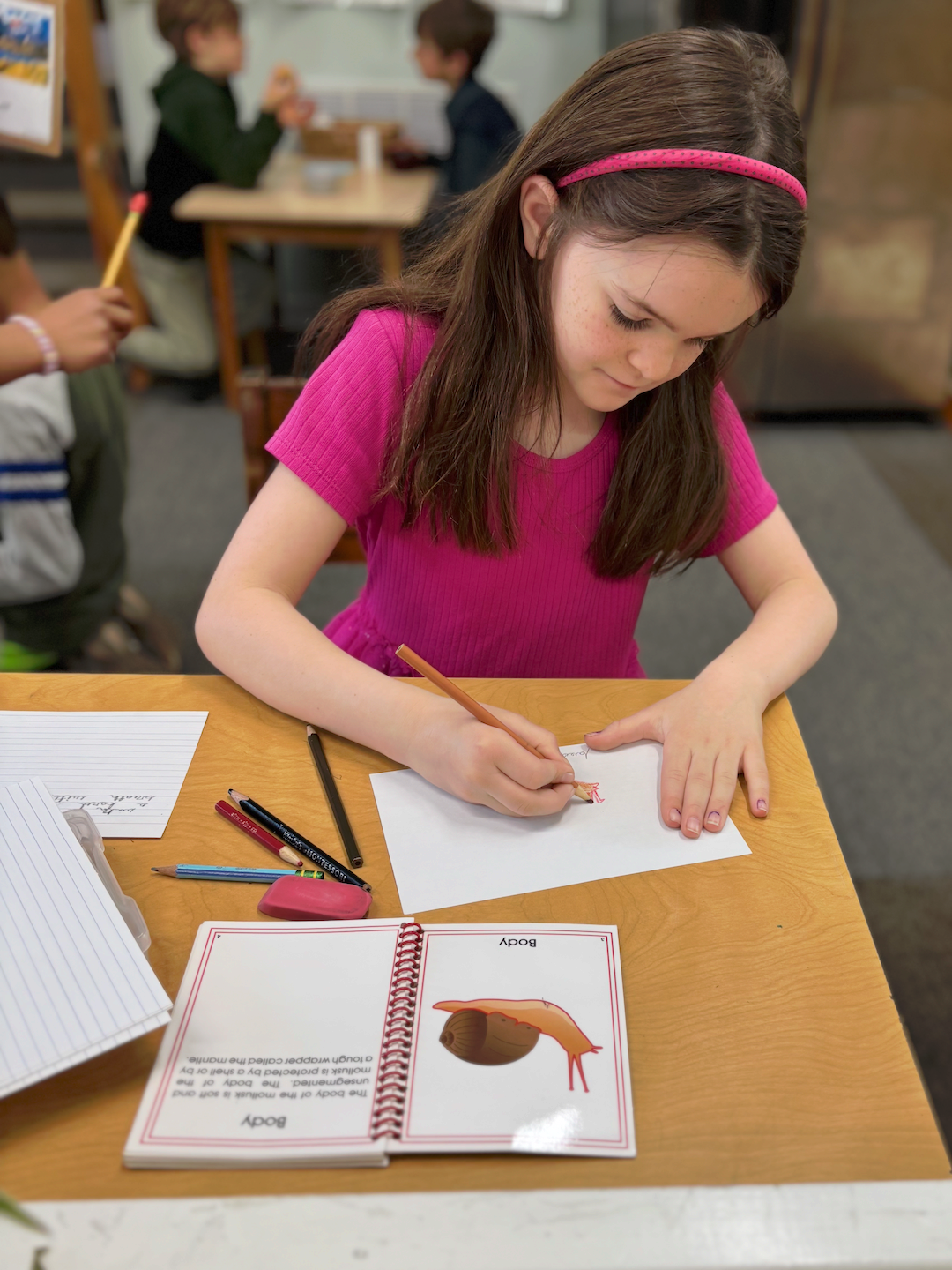
In a Montessori environment, children are introduced to profound, fascinating areas of study early in their educational journey. Science is no exception. At Acorn Montessori School, one of the most vibrant components of both our Primary and Elementary classrooms is the study of zoology.
This post highlights the content covered in our zoology curriculum and explores how students interact with this purposeful work across different developmental stages.
Starting with the Big Picture: Cosmic Education
In the Montessori world, learning always begins with the largest, overarching concept before narrowing down to specific details. This approach provides children with a firm structural framework and context where they can naturally categorize new details.
To introduce life on our planet, we begin with a macro-level look at the Five Kingdoms of Nature:
- Monera
- Protista
- Fungi
- Plants
- Animals
Initial lessons are impressionistic and accessible; they define the core characteristics of each kingdom using clear language and high-quality photographs.
A unique feature of this curriculum is its layered utility. A lesson on the five kingdoms can be introduced to a three-year-old to spark wonder, and then revisited years later in the Elementary classroom when the child is ready to analyze taxonomy deeply. This adaptability is essential for supporting a multi-age classroom environment.
Categorizing the Animal Kingdom
Once children possess a baseline understanding of the five kingdoms, they begin sorting the animal kingdom specifically. The first step in this taxonomy is distinguishing between vertebrates and invertebrates. Children learn the evolutionary advantages of a spinal column, discover when the earliest vertebrates emerged on Earth, and classify modern creatures based on these traits.
Vertebrate Classes and Developmental Progression
Within our curriculum, the study of the vertebrate classes is intentionally designed to grow alongside the child's expanding developmental capacity. In the Primary and early Elementary environments, the initial focus centers on basic identification, nomenclature, and external anatomy. As children progress through the Elementary program, this foundation expands into a deep exploration of physiology and behavioral adaptations.
- Fish: Students begin with external anatomy and basic nomenclature, which later matures into a detailed study of external parts, respiratory mechanics, and specific habitat adaptations.
- Amphibians: Early lessons focus on distinguishing core characteristics, which then progress into tracking complete life cycles, studying metamorphosis, and analyzing physical needs.
- Reptiles: Children move from basic identification and naming to researching complex internal body functions, circulatory systems, and survival traits.
- Birds: The curriculum advances from identifying basic anatomy and structural features to investigating skeletal adaptations for flight, varied egg types, and migration patterns.
- Mammals: Students shift from recognizing familiar features to conducting advanced research into complex body systems, reproductive traits, and environmental interactions.
A Layered, Spiral Curriculum
Because our classrooms span multiple age groups, the curriculum spirals to meet the developmental capacity of the child. For example, consider how two different ages approach the study of a reptile:
The Six-Year-Old (Early Elementary)
A child entering the Elementary classroom is often consolidating their reading skills. Their work with zoology focuses heavily on nomenclature and external parts. When studying a turtle, they learn to identify and label the head, feet, tail, and the specific parts of the shell: the plastron, carapace, and bridge. These precise terms satisfy the child's developmental appetite for rich vocabulary.
The Seven-Year-Old (Second Year Elementary)
Across the table, an older peer uses the same specimen to study internal physiology. They discover how the turtle meets its fundamental needs for movement, respiration, protection, support, circulation, and reproduction. Their research reveals that reptiles possess a three-chambered heart, breathe oxygen through lungs, and protect their offspring by laying leathery eggs.
Older Elementary Students
As students grow into the upper levels of the classroom, they review and solidify this knowledge through cooperative classification games (similar to a precise, scientific variation of twenty questions). They conduct independent research on species that interest them, learning how to cross-reference resources, organize data, write formal reports, and present their findings to the community.
The Purpose of Three-Part Cards
Many areas of study in our classrooms rely on a classic Montessori material known as Three-Part Cards. These materials are specifically designed to foster independent exploration and self-correction.
Primary Level
In the Primary environment (ages 3–6), a nomenclature set consists of an unlabelled picture card, a separate text label card, and a unified control card showing the picture and label together. The child matches the label to the picture and uses the control card to verify their own accuracy without requiring adult correction.
Elementary Level
At the Elementary level, the material evolves to match the child's advanced reading capacity. The cards expand to include a picture, a label, and a detailed definition paragraph. The control feature shifts to an associated booklet or a wall chart. This structure allows the student to refine their reading comprehension, vocabulary, and scientific understanding simultaneously.
Cross-Curricular Connections: Linking Science to History
The study of zoology at Acorn does not exist in isolation; it integrates directly with our history and geography curricula through a foundational material called the Timeline of Life.
The Timeline of Life is a long, beautifully illustrated chart that visualizes the evolution of living organisms on Earth. Students trace life from the early Paleozoic era—where simple, single-celled organisms and invertebrates inhabited prehistoric seas—through the rise of reptiles and mammals, leading up to the Quaternary period and the emergence of early humans.
By observing where specific animals appear on the timeline, children connect their isolated zoology lessons back to the vast story of our universe, bringing their learning full circle.