Think back to your own grade school days: what do you remember learning about history? For many of us, it was a collection of dates and names, often focused narrowly on our own country, and rarely taking up much of the school day. In-depth history usually didn’t happen until high school, and even then, it often felt like a series of disconnected events.
At Acorn Montessori School, we take a different approach. As with all subjects in our curriculum, we begin with the "Big Picture" and gradually zoom in on the details. We start at the very beginning—the birth of the universe—to give our students a frame of reference where everything makes sense, stays interesting, and connects to the world they see today on our Lebanon campus.
A Shared Journey
History is unique in the Montessori classroom because it is one of the few areas where students often receive group lessons. Because children in our multi-age Elementary communities are developmentally primed for big, "impressionistic" stories, these lessons spark shared wonder. As they revisit these stories each year, they discover new layers of meaning and complexity.
Here is an overview of how history unfolds for an Acorn student:
The Creation of the Universe (The First Great Lesson)
Early in the school year—often in the very first week—our Lower Elementary guides present a dramatic lesson on the beginnings of the universe. In a darkened room, through storytelling and live "science experiments," students learn about the Big Bang, the formation of stars, and the laws of chemistry and physics. The lesson culminates in the "eruption" of a model volcano, leaving children in awe of the Earth's geological history.
The Concept of Time
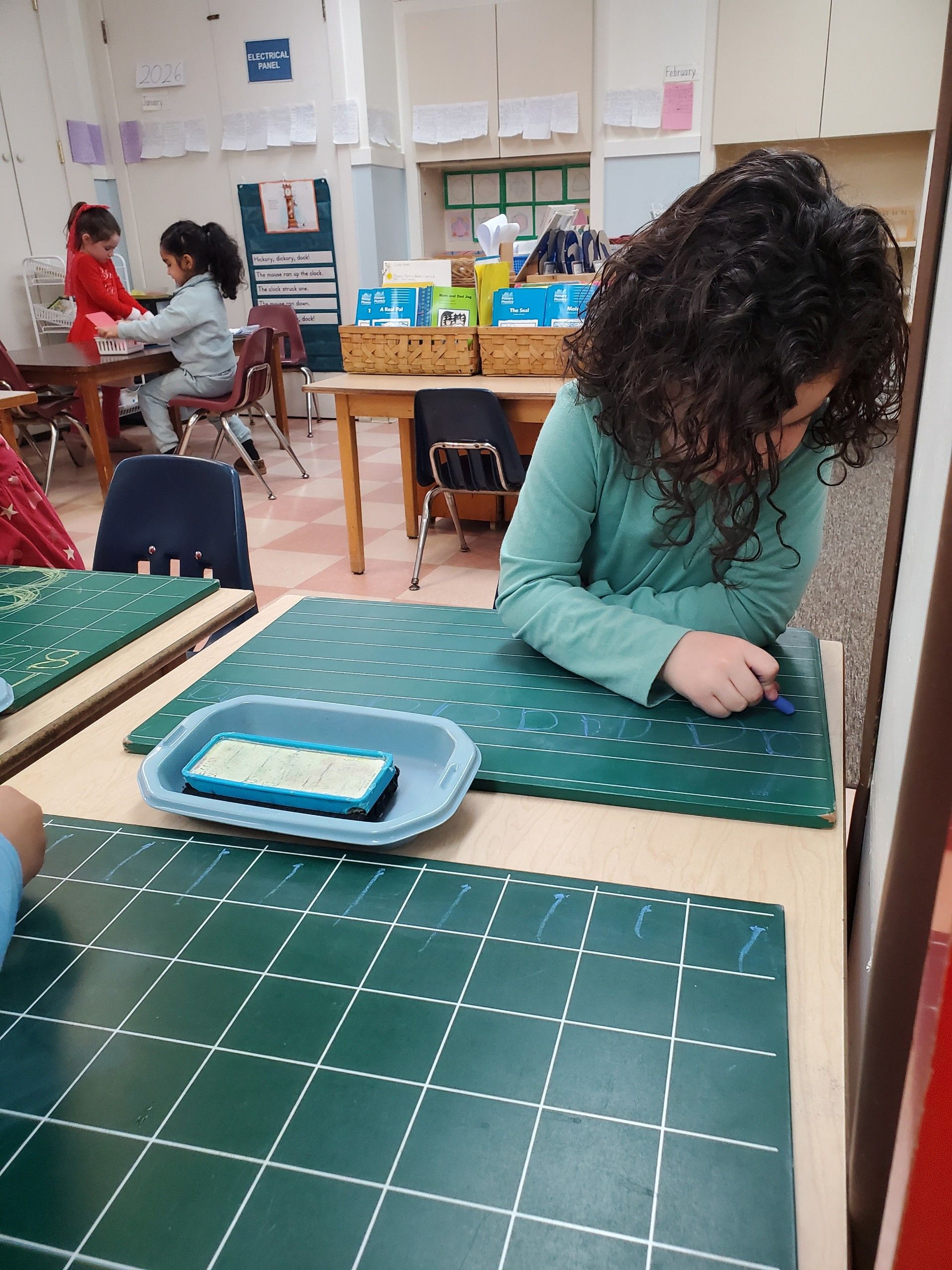
Before diving into eras, children must understand the mechanics of time. Using Montessori fraction materials, students explore how a year is divided. They create their own timelines and master the clock. This work eventually bridges into language, as they connect the passing of time to the three fundamental tenses: past, present, and future.
The Long Black Strip
This lesson is so massive it requires a long hallway or a trip outside to our five-acre grounds. The guide unrolls a 30-meter strip of black felt. Each centimeter represents a million years of Earth's history. As the strip stretches on and on, representing the time before humans, the children follow along until the very end, where a tiny sliver of white represents all of human history. It is a powerful visual that puts our place in the universe into perspective.
The Clock of Eras
To further internalize these massive stretches of time, we use the Clock of Eras. This visual aid imagines Earth's history as a twelve-hour clock. Students can see at a glance how long the Earth was home to only one-celled organisms, and how relatively recently complex life—and finally, humanity—arrived.
The Timeline of Life
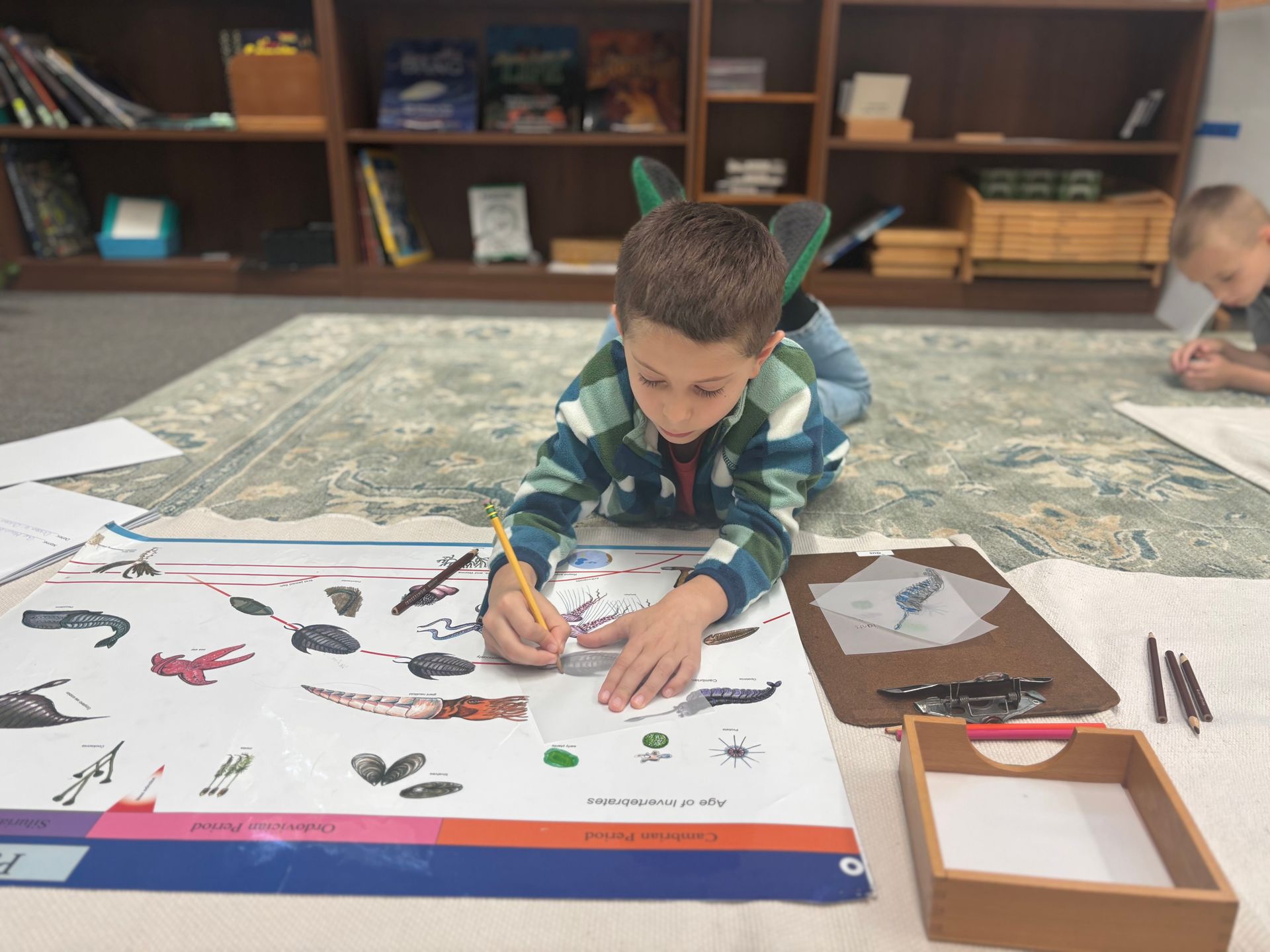
This beautifully illustrated material shows how life evolved from the Paleozoic Era to the present. Students are fascinated by strange early life forms and love discovering which organisms adapted to survive across millions of years. This work naturally leads to deep research into biology and ecology.
Fundamental Needs of Humans
At the heart of our history curriculum is the study of what makes us human. Students explore the basic needs we all share—food, shelter, clothing, defense, and even spiritual and artistic expression. They compare how they meet those needs today with how different cultures and civilizations met them throughout time.
The Progress of Civilization
In our Upper Elementary program, students use their refined research skills to dive deep into ancient and modern cultures. They explore how civilizations functioned, moved, and changed the course of world history. By understanding the progress of those who came before us, students develop a profound respect for human innovation and our global community.
By the time an Acorn student completes our Elementary program, history is not just a list of facts—it is a story they belong to. They walk away with a solid foundation that allows them to appreciate and critically analyze any historical study they encounter in the future.
Want to see our "Great Lessons" in action? We invite you to
visit our campus and observe the wonder of a Montessori classroom firsthand.