Whether we eagerly embrace math or feel a bit intimidated by it as adults, human beings naturally possess a "mathematical mind." We are wired to think in patterns, quantify our surroundings, and make logical connections.
Young children have an incredibly strong, innate inclination toward this type of thinking. At Acorn Montessori School, we take advantage of this natural window of development. In our Primary classrooms (ages 3 to 6), we offer hands-on, sequential learning experiences that provide children with a remarkably deep, joyful understanding of mathematics long before they encounter traditional worksheets.
The mathematical progression in an Acorn classroom is beautifully organized into six progressive areas, moving seamlessly from a foundational understanding of numbers 1 to 10 all the way to early work with fractions.
1. Numbers 1 to 10: Building the Foundation
Learning the numbers 1 to 10 sounds simple, but it actually requires a child to integrate several distinct concepts: quantity, symbol, and sequence. The beauty of Montessori design is that our materials isolate each separate concept so that a child’s understanding grows step-by-step.
- The Number Rods: Our youngest students begin with large wooden rods color-coded in alternating red and blue sections. Because the "3 rod" is physically three times longer than the "1 rod," children solidify the concept of quantity as a single, physical entity while practicing one-to-one correspondence.
- The Sandpaper Numbers: Children trace textured numerals with their fingers, connecting the muscular and visual memory to the symbolic representation of the number.
- Spindle Boxes and Cards & Counters: Once symbols and quantities are understood individually, children practice pairing them. Materials like the Spindle Boxes introduce the profound concept of zero—an empty box—and transition the child from seeing quantity as a solid rod to seeing it as a loose set of individual objects.
Throughout this early stage, we offer experiential exercises that give children a concrete impression of addition, subtraction, multiplication, and division. Long before they learn the formal words or math symbols, they intuitively know what it feels like to join groups together or distribute them equally.
2. The Decimal System: Working into the Thousands
Once a child comfortably masters 1 to 10, they are introduced to one of the most iconic areas of our classroom: the Golden Beads.
Because a child already understands the numbers 1 through 9, they are ready to learn the geometric and physical hierarchy of the decimal system. In this material:
- A single golden bead represents 1 Unit.
- Ten units wired together in a straight line represent 1 Ten.
- Ten bars laid side-by-side form a flat square representing 1 Hundred.
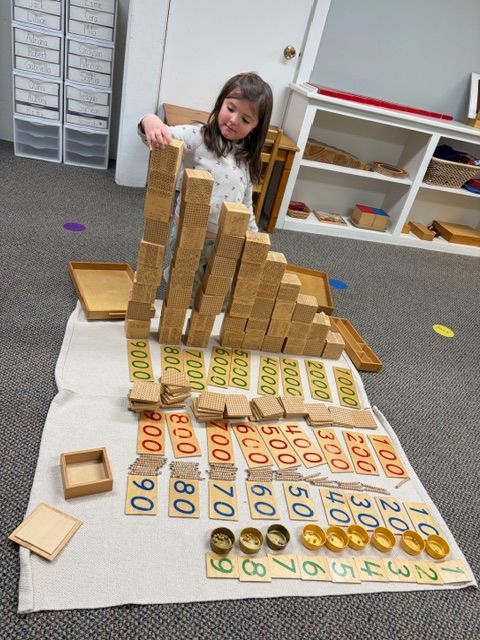
- Ten hundred squares stacked together form a heavy, three-dimensional cube representing 1 Thousand.
Holding a single unit bead in one hand and a heavy thousand cube in the other gives the child a profound, physical impression of scale. Using these beads, four- and five-year-olds enthusiastically perform 4-digit addition and subtraction equations (e.g., 3,452 + 1,235) by physically combining the beads on a mat and counting them up.
At Acorn, our focus at this stage is entirely on the process of the operation. We aren't simply looking for a quick "right answer"; we want the child to internalize what it truly means to add, multiply, divide, or subtract. As they grow confident, they transition to slightly more abstract materials like the Stamp Game and Dot Game, which bridge the gap between concrete beads and written math.
3. Continuation of Counting: From 11 to 1,000
Simultaneously, children expand their linear counting skills. Using the Teen Boards and Tens Boards, they learn how numbers combine sequentially (seeing physically how a "10" and a "3" slide together to form "13").
We also introduce the brilliant Colored Bead Stair—a vibrant, color-coded representation of quantities 1 through 10. This specific color pattern is replicated across all higher-level Montessori math materials, providing a familiar visual anchor as the math becomes more complex.
With the long Bead Chains, children unfold loops of beads across the classroom floor, experiencing the dramatic linear difference between 100 and 1,000. These chains are also used for skip-counting, which effortlessly lays the neurological foundation for future multiplication tables.
4. Exploration and Memorization of Math Tables
To help children memorize essential math facts without dry flashcards, the Primary environment provides an array of interactive games:
- The Addition and Subtraction Strip Boards
- The Addition and Subtraction Snake Games
- The Multiplication Bead Board and Unit Division Board
This concrete exploration establishes a vivid visual and muscular memory of what an equation looks like. A child learns that $5 \times 6$ is exactly five rows of six beads arranged in a perfect rectangle.
Through joyful repetition, children naturally become aware of which combinations they know by heart and which they still need to count. Eventually, they arrive at a wonderful breakthrough: they realize it is much faster to do the calculation mentally than to lay out the materials. Their mind is ready to step away from the concrete.
5. The Passage to Abstraction
As children reach the final year of their Primary cycle (the kindergarten year), their desire for efficiency grows. This is the moment for the passage to abstraction, where knowledge shifts from understanding concepts experientially to understanding them logically.
Children begin utilizing the Small Bead Frame to mentally calculate larger addition and subtraction problems. They also explore the Wooden Hierarchy Material, which provides a breathtaking look at quantities up to one million. With years of concrete foundations supporting them, they easily map out large mathematical concepts on paper with absolute confidence.
6. Fractions: Exploring Parts of a Whole
The final material in the Primary mathematical progression introduces fractions. Using inset metal circles divided into halves, thirds, fourths, and down to tenths, children explore quantities smaller than one unit. Because they can take a one-third piece and physically see that it is larger than a one-fifth piece, they avoid the common traditional pitfall of assuming a larger denominator means a larger fraction. They even begin performing simple, sensory equations and discovering the concept of equivalence entirely on their own.
A Foundation for Life
The mathematical journey at Acorn Montessori School ensures that math is never associated with anxiety, speed drills, or memorization without context. By grounding every abstract concept in a rich, physical experience first, we protect a child's natural confidence and reason. When children are allowed to follow their mathematical instincts this way, math ceases to be a chore—it becomes an exciting puzzle they are eager to solve.
Want to see our students’ mathematical minds in action? We invite you to step inside our classrooms and experience the Montessori difference firsthand.